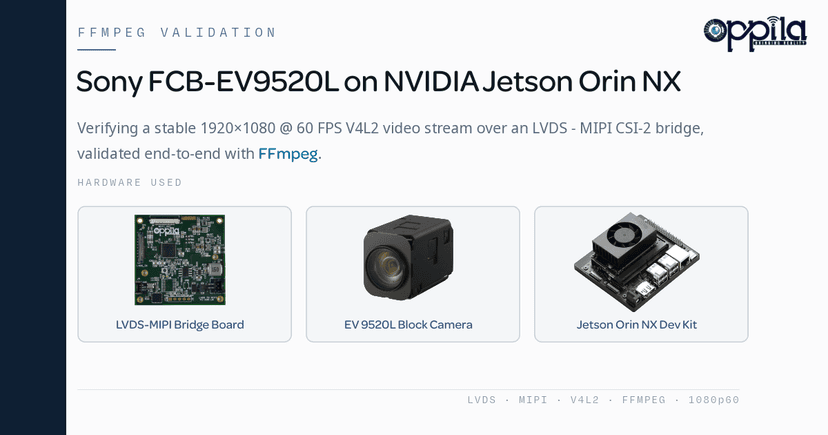
Tamron MP3010M-EV + Raspberry Pi 5 | LVDS to MIPI CSI-2 Integration (1080p60 AI Vision)
Introduction
Connecting industrial cameras like the Tamron MP3010M-EV to Raspberry Pi 5 is not straightforward because it only supports MIPI CSI-2 cameras.
The LVDS to MIPI CSI-2 Bridge solves this by converting the camera's LVDS output into a MIPI CSI-2 stream that Raspberry Pi can capture natively.
This setup delivers:
- Full HD 1080p @ 60fps video
- Ultra-low latency streaming
- High-quality optics with minimal distortion
- AI-ready embedded vision pipeline
Ideal for robotics, surveillance, industrial vision, and IoT applications.
LVDS to MIPI CSI-2 Conversion
The bridge converts the Tamron camera's LVDS output into MIPI CSI-2 — the native interface supported by Raspberry Pi 5.
Key Features
- 4-lane MIPI CSI-2 output
- High-Speed (HS) & Low-Power (LP) signaling
- ECC + CRC error protection
- Fixed 1080p60 output
- Ultra-low latency pipeline
Tamron MP3010M-EV Camera Integration
The Tamron MP3010M-EV is a compact, high-performance Full HD camera module designed for embedded and industrial applications.
Camera Highlights
- Full HD 1920×1080 video output
- Compact size (~59mm length, ~70g weight)
- High optical performance with low distortion
- LVDS digital output interface
- Optimized for small-size embedded systems with high image quality
Advanced Imaging Features
Imaging & Control Capabilities
- Optical zoom + digital zoom support
- Auto / manual focus modes
- Wide Dynamic Range (WDR) for high contrast scenes
- Defog and Noise Reduction (2D / 3D NR)
- White balance modes (Auto / Manual / One-push)
- IR Cut filter for day/night operation
Why This Setup is Powerful
Once connected:
- Works with libcamera / rpicam tools
- Uses Raspberry Pi ISP (PiSP)
- Compatible with OpenCV & AI pipelines
- Enables real-time inference with low latency
Custom Driver for Raspberry Pi 5
Oppila provides a driver compatible with Raspberry Pi's camera ecosystem.
Driver Capabilities
- Device Tree overlay support
- LVDS → YUV (UYVY) conversion
- Native libcamera support
- Automatic link detection
- Plug-and-play integration
Camera Control (VISCA Protocol)
The Tamron camera supports VISCA protocol for advanced control.
Control Flow
Raspberry Pi → I2C → Bridge → UART → Tamron Camera
Control Features
- Optical & Image
- Zoom control (optical + digital)
- Auto/manual focus
- Iris, gain, shutter
Image Processing
- WDR
- Noise reduction (2D/3D NR)
- White balance
- Defog
Advanced
- Exposure modes (Auto / Manual / Priority)
- Preset configurations
Hardware Setup
Required Components
- Raspberry Pi 5
- LVDS → MIPI CSI-2 Bridge
- Tamron MP3010M-EV camera
Connections
- LVDS → Bridge
- Bridge → Raspberry Pi CSI port
- UART → Camera control
Power
- Bridge: 12V DC
Real-Time Video Streaming
After driver setup, access video via /dev/video0.
Basic Pipeline
gst-launch-1.0 v4l2src device=/dev/video0 ! video/x-raw,format=UYVY,width=1920,height=1080,framerate=60/1 ! videoconvert ! autovideosink
Performance Benefits
- Smooth 1080p60 playback
- Low CPU usage
- No frame drops
- Efficient pipeline
Applications
- Robotics & automation
- UAV / drone vision
- Industrial inspection
- Surveillance systems
- IoT edge AI vision
Why Choose This Setup?
- Compact & lightweight camera design
- High-quality Full HD imaging
- High-sensitivity STARVIS low-light performance
- Cost-effective Raspberry Pi platform
- Plug-and-play integration
- AI-ready pipeline
Conclusion
LVDS to MIPI CSI-2 Bridge enables seamless integration of the Tamron MP3010M-EV with Raspberry Pi 5, delivering a compact yet powerful embedded vision solution.
With Full HD 1080p60 streaming, high-sensitivity STARVIS imaging, and AI-ready compatibility, this setup is ideal for modern edge applications including robotics, drones, and industrial automation.
Product Details
Block camera used in this guide: Tamron MP3010M-EV – Ultra-Compact STARVIS Block Camera
FAQs
Yes, using an LVDS to MIPI CSI-2 bridge, it works like a native Pi camera.
It supports Full HD 1920×1080 at up to 60fps.
No, a bridge is required to convert the LVDS signal to MIPI CSI-2.
It is a hardware adapter that converts a camera's LVDS output into Raspberry Pi-compatible MIPI CSI-2 format.
Yes, the setup is fully compatible with libcamera and rpicam tools on Raspberry Pi 5.
Yes, using VISCA protocol commands sent via UART through the bridge.
The camera supports VISCA protocol for zoom, focus, iris, and advanced image control.
Yes, it is compatible with OpenCV, TensorFlow Lite, and other AI frameworks on Raspberry Pi 5.
Robotics, UAV/drone vision, surveillance, industrial inspection, and IoT edge AI.
Yes, with IR cut filter, exposure control, and WDR for improved imaging in low-light scenes.
Yes, using rpicam-vid or GStreamer pipelines to record to file or stream over network.
Yes, the bridge delivers ultra-low latency with no frame drops at 1080p60.
Yes, it is approximately 59mm in length and weighs around 70g, making it ideal for embedded systems.
Yes, it is suitable for industrial and commercial deployments with plug-and-play integration.