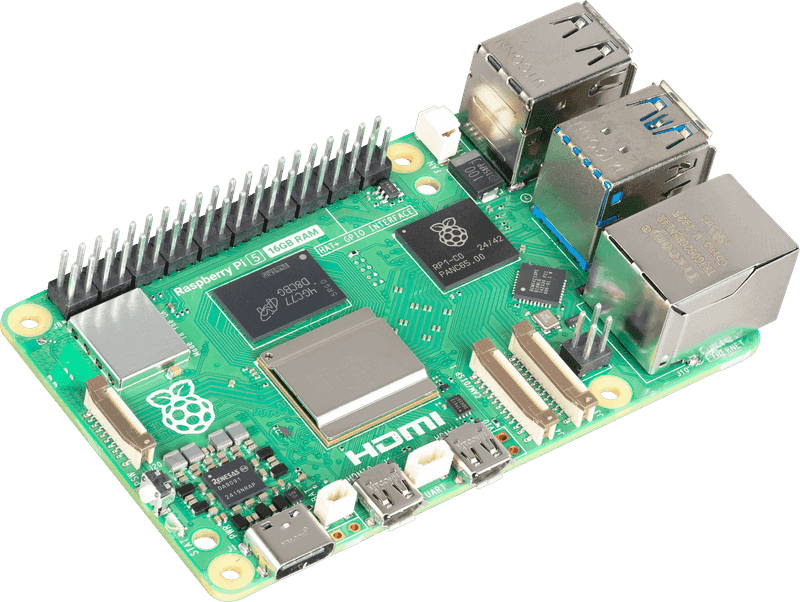
MIPI CSI-2 Driver - Raspberry Pi
High-Performance Camera Drivers for Raspberry Pi Platforms
MIPI CSI-2 Camera Driver Development for Raspberry Pi Platforms
We provide turnkey, production-grade Linux MIPI CSI-2 camera driver stacks tailored for the Raspberry Pi 5 platform. Supporting any sensor vendor, we deliver the complete solution: V4L2 sub-device drivers, media-controller pipelines, rp1-cfe / PiSP Back End integration, device-tree overlays, power sequencing, dual 4-lane support, RAW/YUV passthrough, libcamera IPA tuning, and production SD/NVMe flashing packages.
- Raspberry Pi 5 (BCM2712) + RP1 companion chip (rp1-cfe, pisp-be)
- Mainline 6.x and Raspberry Pi BSP support (6.6 / 6.12 rpi-2712)
- Sony IMX219 / IMX477 / IMX708 and custom bridge chips (LT9211C, TC358743) full integration
- One driver package — tested on your hardware, delivered with build scripts, media-ctl pipeline configurations, and production flashing instructions.
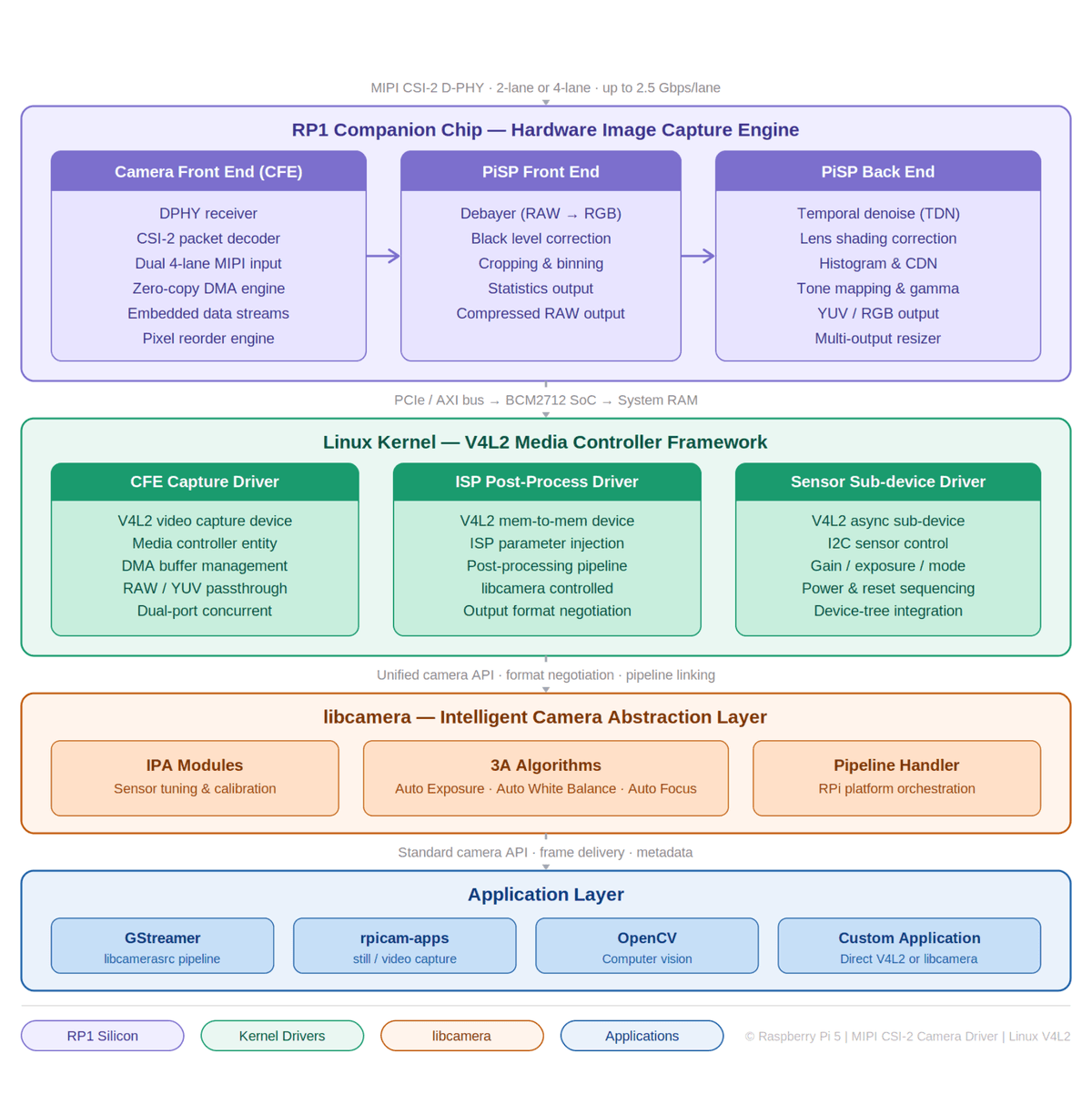
The Raspberry Pi 5 implements MIPI CSI-2 through the RP1 companion chip, which contains the Camera Front End (rp1-cfe) — a hardware DPHY receiver and CSI-2 packet decoder with direct DMA to system RAM — paired with the PiSP Front End and PiSP Back End for ISP processing. Both CAM0 and CAM1 ports support up to 4-lane MIPI CSI-2 at 2.5 Gbps per lane. The Linux kernel exposes this through the V4L2 media-controller framework: sensor drivers register as V4L2 async sub-devices, rp1-cfe creates /dev/video0–video3 and /dev/media0, and pisp-be handles post-processing on /dev/video13–video31. Device-tree overlays (DTBO) define data-lanes, link-frequency, hs-settle, and sensor power/reset GPIOs. Userspace configures pad formats and pipeline links via media-ctl and v4l2-ctl, with libcamera providing 3A (AE/AWB/AF) and ISP tuning through its IPA module. Software builds use the Raspberry Pi BSP kernel (rpi-2712, 16K page) or mainline, deployed via SD card image or NVMe with Raspberry Pi Imager / SDK.