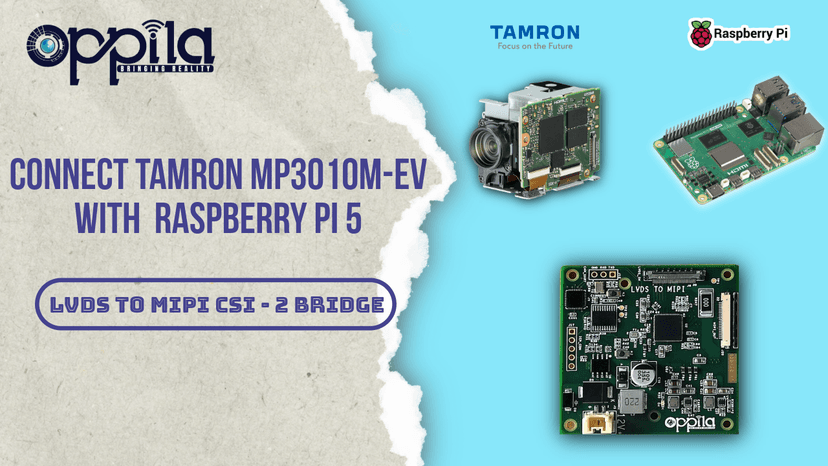
KT&C ATC-HZ5540T-LP + Raspberry Pi 5 | LVDS to MIPI CSI-2 Integration (1080p60 Global Shutter AI Vision)
Introduction
Connecting industrial LVDS cameras to Raspberry Pi 5 isn’t straightforward — because the Pi only supports MIPI CSI-2 cameras.
The Oppila LVDS to MIPI CSI-2 Bridge solves this problem by enabling seamless integration of the KT&C ATC-HZ5540T-LP 40× optical zoom Global Shutter camera with Raspberry Pi 5.
This setup delivers:
- 1080p @ 60fps real-time video
- Ultra-low latency streaming
- Global Shutter (no motion blur)
- AI-ready embedded vision pipeline
Ideal for ALPR, robotics, surveillance, and industrial inspection
YouTube Video
LVDS to MIPI CSI-2 Conversion
The bridge converts the camera’s LVDS output into MIPI CSI-2 — the native interface supported by Raspberry Pi 5.
Key Features
- 4-lane MIPI CSI-2 output
- High-Speed (HS) & Low-Power (LP) signaling
- ECC + CRC error protection
- Fixed 1080p60 output
- Ultra-low latency pipeline
KT&C ATC-HZ5540T-LP Camera Integration
The KT&C ATC-HZ5540T-LP is a high-performance industrial zoom camera designed for precision vision applications.
Camera Highlights
- 1/2.9" Global Shutter CMOS sensor
- 40× optical zoom (long-range capture)
- Native 1080p60 LVDS output
- Global Shutter → eliminates motion blur
- Excellent low-light performance (~0.01 Lux)
When connected through the bridge, it behaves like a native Raspberry Pi camera, enabling seamless capture.
Why This Setup is Powerful
Once connected:
- Works with libcamera / rpicam tools
- Uses Raspberry Pi’s ISP (PiSP)
- Enables real-time AI processing
- No frame drops or lag
Custom Driver for Raspberry Pi 5
Oppila provides a driver fully compatible with the Raspberry Pi camera ecosystem.
Driver Capabilities
- Device Tree overlay support
- LVDS → UYVY conversion
- Native support for libcamera
- Automatic link detection
- Plug-and-play camera access
Camera Control (VISCA / Pelco)
The bridge includes I2C-to-UART control for real-time camera control.
Control Flow
Raspberry Pi → I2C → Bridge → UART → KT&C Camera
Supported Protocols
- VISCA
- Pelco-D
- Pelco-P
Control Features
- Optical & Image
- 40× zoom control
- Auto/manual focus
- Iris, gain, shutter
Image Processing
- WDR
- 3D noise reduction
- White balance
- Defog
Operational
- Presets
- Day/Night mode
- Power control
Hardware Setup
Required Components
- Raspberry Pi 5
- Oppila LVDS → MIPI CSI-2 Bridge
- KT&C ATC-HZ5540T-LP camera
Connections
- LVDS → Bridge
- Bridge → Pi CSI port
- UART → Camera control
Power
- Bridge: 12V DC
Real-Time Video Streaming
Once setup is complete, the camera is accessible via:
/dev/video0
Basic Pipeline
gst-launch-1.0 v4l2src device=/dev/video0 ! video/x-raw,format=UYVY,width=1920,height=1080,framerate=60/1 ! videoconvert ! autovideosink
Performance Benefits
- Smooth 1080p60 playback
- Low CPU usage
- No dropped frames
- Hardware-accelerated pipeline
Applications
- ALPR / ANPR systems
- Smart surveillance
- Industrial inspection
- Robotics & automation
- IoT edge vision
Why Choose This Setup?
- Global Shutter → no motion blur
- 40× zoom → long-distance detection
- Raspberry Pi 5 → cost-effective platform
- Multi-protocol control (VISCA + Pelco)
- Plug-and-play integration
- Compact & production-ready
Conclusion (High-Impact)
The Oppila LVDS to MIPI CSI-2 Bridge enables seamless integration of the KT&C ATC-HZ5540T-LP Global Shutter camera with Raspberry Pi 5, unlocking powerful embedded vision capabilities. With 1080p60 real-time streaming, 40× optical zoom, and motion-free global shutter imaging, this setup delivers industrial-grade performance on a compact and cost-effective platform. Whether you're building ALPR systems, robotics solutions, or smart surveillance, this is a scalable and efficient solution for modern edge AI vision.
Product Details
Full specifications, kits, and datasheets: LVDS to MIPI CSI-2 Bridge
Block camera used in this guide: KT&C ATC-HZ5540T-LP – 40x Global Shutter Block Camera
FAQs
No, the KT&C ATC-HZ5540T-LP outputs LVDS, while Raspberry Pi 5 requires MIPI CSI-2. Oppila's LVDS to MIPI CSI-2 Bridge converts LVDS → MIPI CSI-2 seamlessly.
The bridge supports 1080p @ 60fps, converted to a format compatible with Raspberry Pi 5's MIPI CSI-2 camera interface.
Global Shutter captures the entire frame simultaneously, eliminating motion blur and rolling shutter artifacts. This is critical for ALPR, machine vision, and any application involving fast-moving objects.
Latency is sub-millisecond and does not affect real-time applications.
Yes. The bridge supports I2C-to-UART control for sending VISCA, Pelco-D, and Pelco-P commands to control zoom, focus, exposure, gain, presets, and triggers.
The camera supports VISCA, Pelco-D, and Pelco-P control protocols via RS232 TTL UART at baud rates from 2400 to 115200 bps.
Yes. It supports all LVDS-compatible camera modules including Sony, Tamron, Wonwoo, Videology, and Skoopia block cameras.
Yes. A custom camera driver and Device Tree Overlay are provided for Raspberry Pi 5's libcamera stack.
Yes. You can use rpicam-hello, rpicam-vid, rpicam-still, GStreamer, and OpenCV.
The bridge requires 12V DC @ 0.8A.
A 22-pin FPC cable connects the bridge to the Raspberry Pi 5's CSI camera input.
No. The system maintains full 60fps with zero frame drops under normal operation.