AI-Powered Automated Defect Detection Using NVIDIA Jetson AGX Orin | High-Performance Industrial Vision with 4K at 60 FPS and Edge AI
Introduction
Industrial manufacturing increasingly relies on automated inspection to maintain product quality, reduce defects and improve production efficiency. Traditional manual inspection methods can be time-consuming and difficult to scale, particularly when consistent inspection is required across high-volume production lines.
AI-powered machine vision offers a smarter approach by enabling systems to identify product defects automatically using deep learning and computer vision.
At Oppila, we demonstrate an industrial vision application combining the Sony FCB-ER9500 camera, Oppila AGX Orin MIPI CSI-2 Bridge Board and NVIDIA Jetson AGX Orin 64GB Developer Kit.
The demonstration brings together high-resolution camera streaming at 4K 60 FPS and AI-based automated screw defect detection, showcasing the capabilities of an integrated Edge AI vision solution.
1. System Architecture: From Industrial Camera to Edge AI
The system is built around three key hardware components:
- Sony FCB-ER9500: Industrial camera with HDMI video output.
- Oppila AGX Orin MIPI CSI-2 Bridge Board: Interfaces the HDMI camera output with the Jetson MIPI CSI-2 camera input.
- NVIDIA Jetson AGX Orin 64GB Developer Kit: Embedded AI computing platform for image processing and deep learning inference.
System Block Diagram
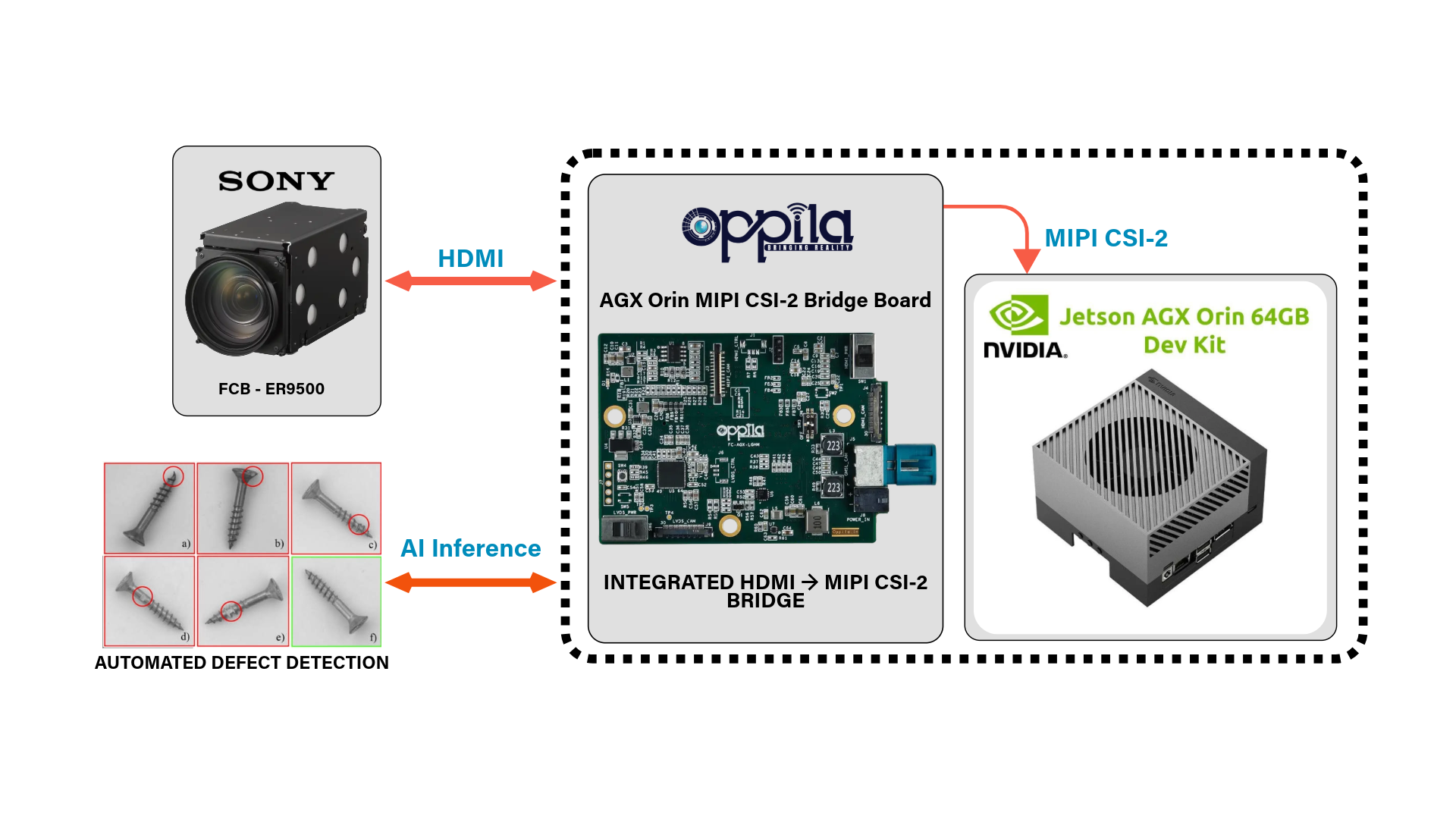
Figure 1: System architecture showing the HDMI-to-MIPI CSI-2 camera bridge between the Sony FCB-ER9500 and NVIDIA Jetson AGX Orin, with AI-based defect detection running on the Jetson platform.
The architecture demonstrates how an HDMI-based industrial camera can be integrated with an embedded computing platform using MIPI CSI-2 connectivity.
The Sony camera supplies the video stream through HDMI. Oppila's AGX Orin MIPI CSI-2 Bridge Board provides the required interface conversion, allowing the Jetson AGX Orin to receive the camera stream through its MIPI CSI-2 interface.
The Jetson platform then executes the AI inference application, analysing the captured screw images and identifying visible defects.
This architecture provides a practical example of combining industrial camera technology with GPU-accelerated Edge AI computing.
2. Hardware Implementation and Camera Integration
Reliable camera interfacing is a critical requirement in embedded vision applications. Industrial cameras often use interfaces such as HDMI, LVDS and GMSL, while embedded platforms commonly provide MIPI CSI-2 camera connectivity.
Oppila's HDMI-to-MIPI CSI-2 Bridge Board addresses this integration requirement by enabling HDMI-based industrial cameras to connect with compatible NVIDIA Jetson platforms.
Actual Hardware Setup
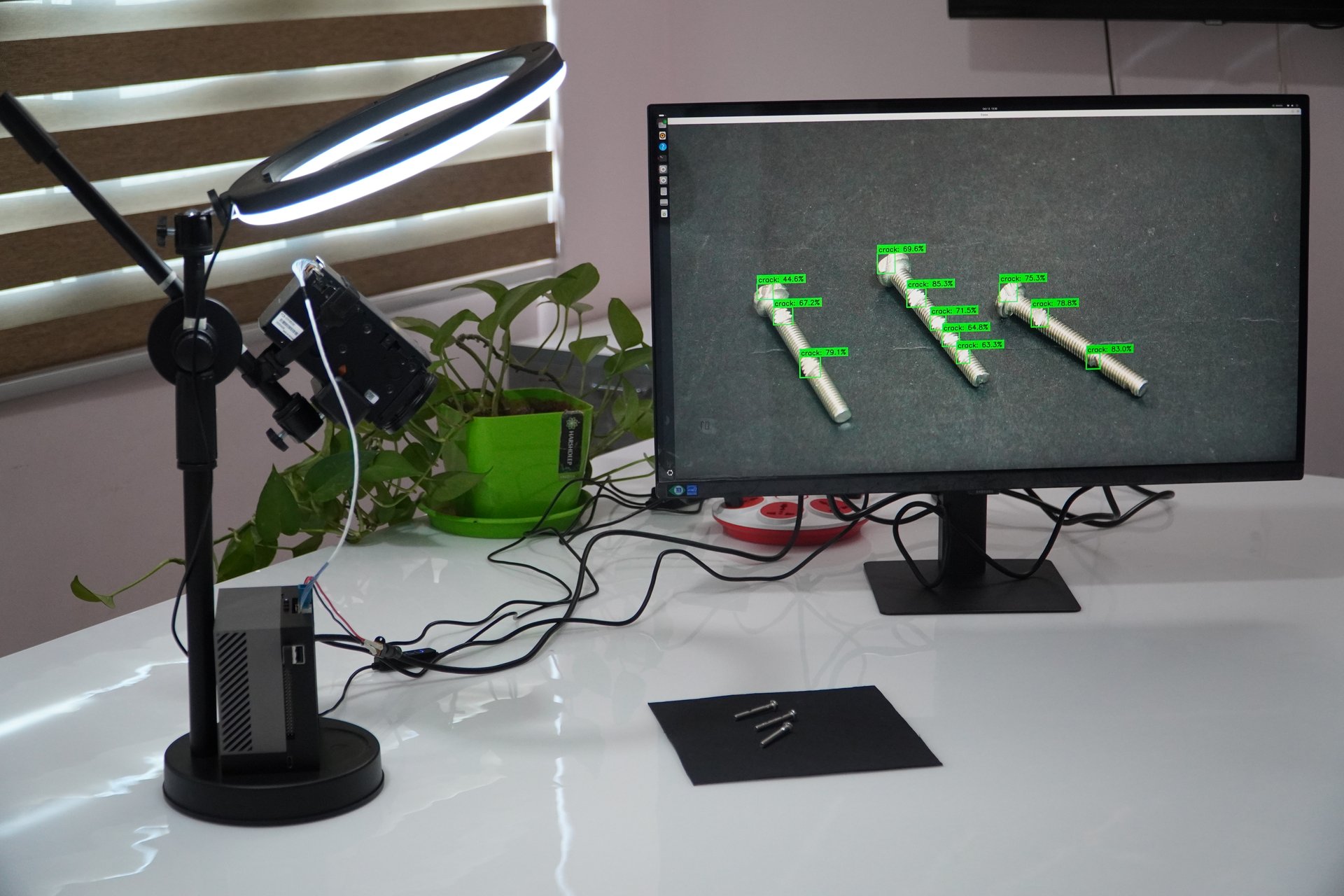
Figure 2: Demonstration setup featuring the Sony FCB-ER9500 camera, Oppila AGX Orin MIPI CSI-2 Bridge, NVIDIA Jetson AGX Orin and live AI inspection output.
The hardware configuration includes:
Sony FCB-ER9500 Camera
Provides industrial image acquisition through its HDMI video output.
Oppila AGX Orin HDMI-to-MIPI CSI-2 Bridge Board
Provides the camera interface conversion required to connect the HDMI video source to the Jetson MIPI CSI-2 interface.
NVIDIA Jetson AGX Orin 64GB Developer Kit
Acts as the central computing platform, providing GPU acceleration for AI inference and computer vision workloads.
Together, these components establish a flexible hardware foundation for developing industrial Edge AI applications.
3. High-Resolution Video Streaming: 4K at 60 FPS
One of the key highlights of this demonstration is 4K video streaming at 60 frames per second.
High-resolution video acquisition is particularly important in industrial inspection, where small surface imperfections, cracks and component-level abnormalities need to be clearly visible.
The combination of 4K resolution and 60 FPS offers two important capabilities:
- Image detail: High-resolution video provides detailed visual information for inspection tasks.
- Frame rate: 60 FPS supports smooth video acquisition, making the solution suitable for applications involving moving components and dynamic inspection environments.
This capability provides a strong foundation for developing high-resolution industrial vision systems where image quality and streaming performance are important.
4. AI-Based Automated Screw Defect Detection
Beyond camera integration and video streaming, the demonstration showcases AI-powered screw defect detection.
The objective is to identify visible defects in screw components automatically, reducing the dependence on manual visual inspection.
The AI inference application running on NVIDIA Jetson AGX Orin analyses the captured images and identifies crack-related defects.
Live AI Detection Results
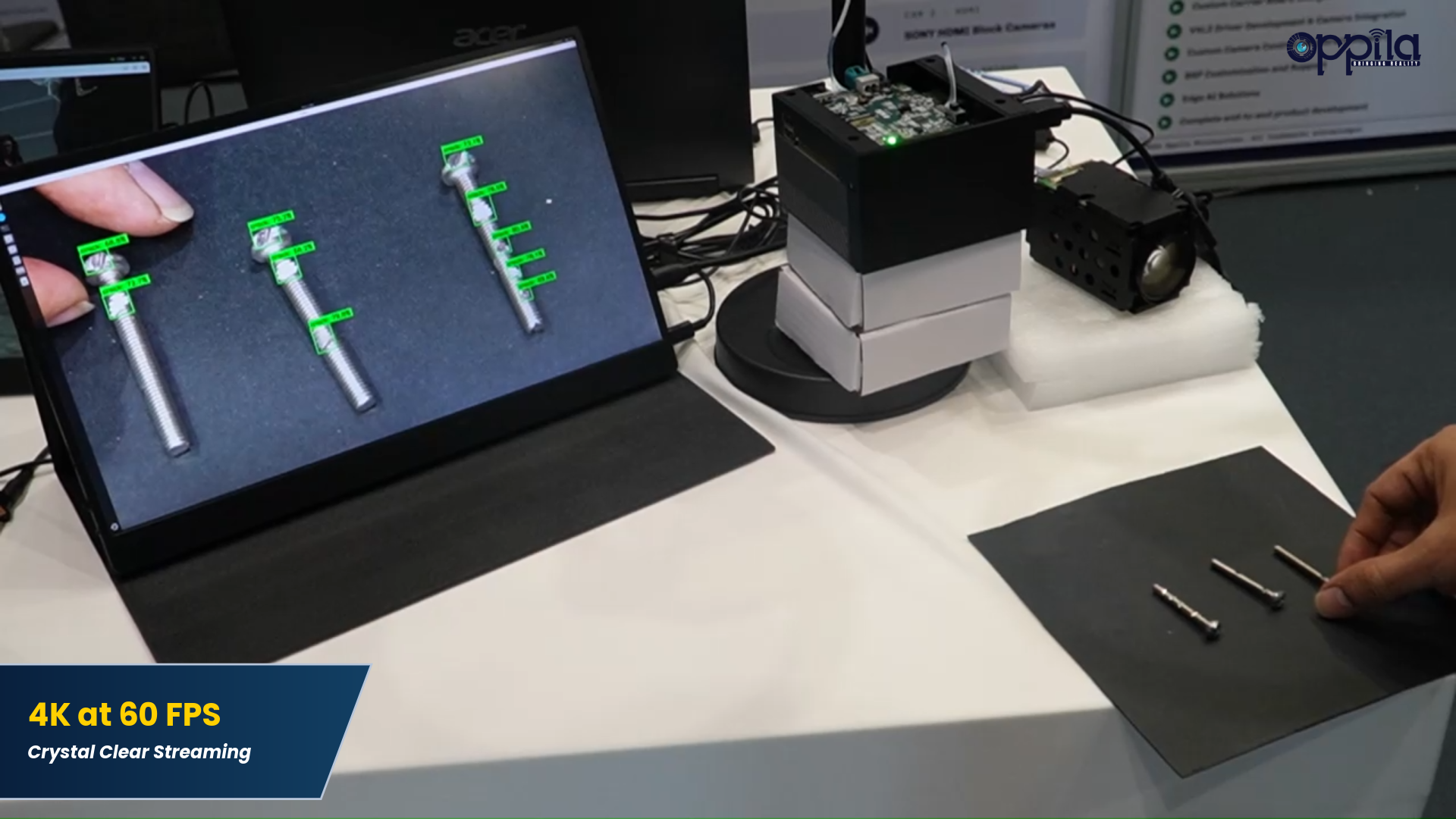
Figure 3: AI-based screw inspection showing detected crack regions with bounding boxes, class labels and confidence scores.
The detection interface displays:
- Defect classification: Identifies regions classified as cracks.
- Bounding boxes: Highlights the detected defect locations within the screw images.
- Confidence scores: Displays the model's confidence for individual detections.
These visual outputs allow operators to understand the inspection results and identify components requiring further examination.
The demonstrated application illustrates how deep learning-based object detection can be used for industrial quality inspection.
5. Potential Industrial Applications
The same combination of industrial camera interfacing and Edge AI computing can support several other computer vision applications.
| Application | Inspection capability |
|---|---|
| Manufacturing quality control | Identification of defective components |
| Surface inspection | Detection of cracks, scratches and abnormalities |
| PCB inspection | Identification of missing components and visible soldering defects |
| Assembly verification | Component presence and positioning checks |
| Object detection | Identification and classification of industrial objects |
| Robotic vision | Camera-based perception for automated systems |
By adapting the AI model and camera configuration to specific requirements, this architecture can serve as a foundation for different industrial inspection applications.
Watch the Complete Demonstration
See how Oppila combines industrial camera integration, high-resolution video streaming and Edge AI computing in this automated defect detection demonstration.
Technologies featured:
- Sony FCB-ER9500 Industrial Camera
- Oppila AGX Orin HDMI-to-MIPI CSI-2 Bridge Board
- NVIDIA Jetson AGX Orin 64GB Developer Kit
- 4K at 60 FPS video streaming
- AI-powered screw defect detection
Build Your Next Edge AI Vision Solution with Oppila
Are you developing an industrial inspection system, automated quality-control solution or AI-powered camera application?
At Oppila, we develop camera interfacing hardware and embedded vision solutions that help engineers integrate industrial cameras with modern embedded computing platforms.
Our solutions support camera integration across multiple hardware ecosystems, including NVIDIA Jetson, Raspberry Pi and NXP-based platforms.
Our product and engineering capabilities include:
- HDMI-to-MIPI CSI-2 Bridge Boards.
- LVDS-to-MIPI CSI-2 Bridge Boards.
- GMSL camera interfacing solutions.
- MIPI CSI-2 camera integration.
- Custom embedded Linux camera driver development.
- BSP and operating system integration.
- Edge AI hardware and software integration.
From camera connectivity to embedded AI deployment, our focus is on simplifying the development of high-performance vision systems.
Connect your cameras. Accelerate your AI applications. Build intelligent vision systems with Oppila.
Watch & Learn More
- Automated defect detection demo video: https://youtu.be/wKVre8_fCCc
- AGX Orin MIPI CSI-2 Bridge Board: https://www.oppila.in/products/agx-orin-mipi-csi-2-bridge
- Sony FCB-ER9500: https://www.oppila.in/products/er9500
Contact Oppila to discuss your camera integration and Edge AI development requirements.