LVDS to USB 3.0 Interface Board — Connect Cameras to Any USB Host
Overview
The LVDS to USB 3.0 Interface Board enables seamless integration of Sony and Tamron FCB block cameras with any standard USB 3.0 host (Windows or Linux).
It converts the LVDS video output from cameras such as Sony FCB-EV9500L and FCB-EV9520L into a UVC-compliant 1080p60 USB stream, ensuring driverless, high-quality video capture.
Setup Block Diagram
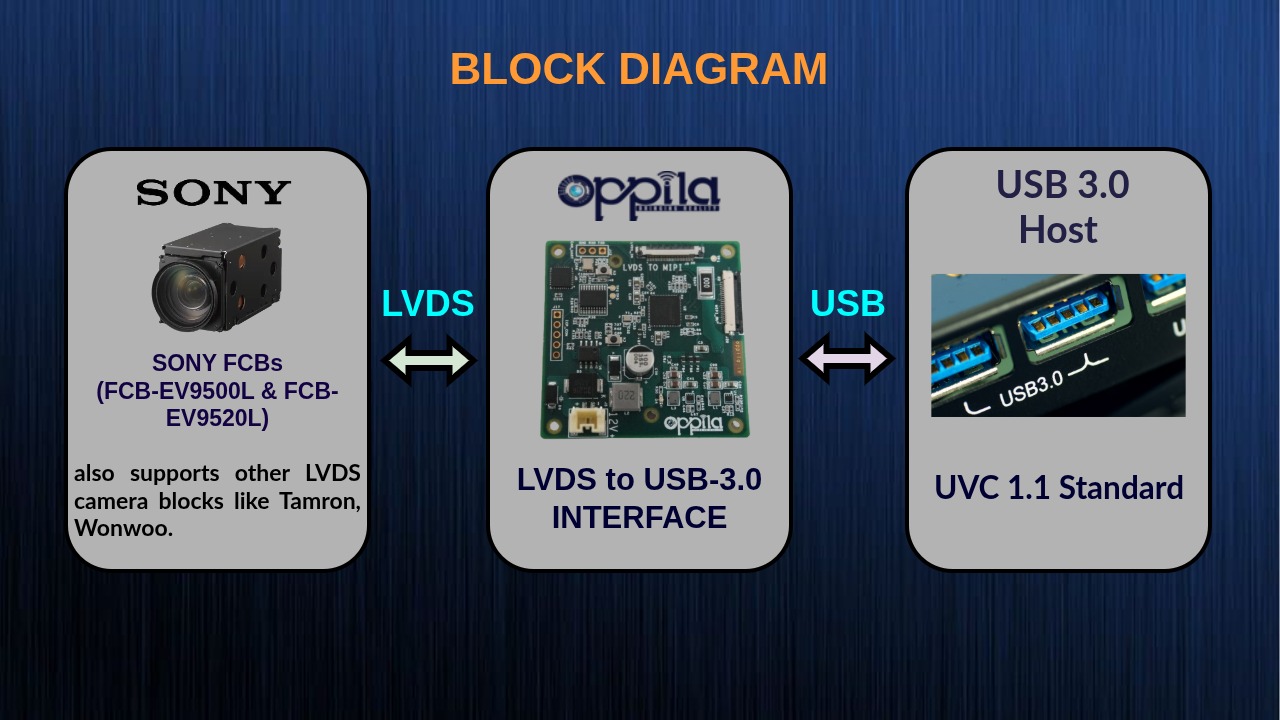
What This Board Does
This board acts as a bridge between LVDS camera output and a USB 3.0 host, enabling:
- Real-time Full HD streaming at 1080p @ 60 fps
- Plug-and-play operation via UVC 1.1
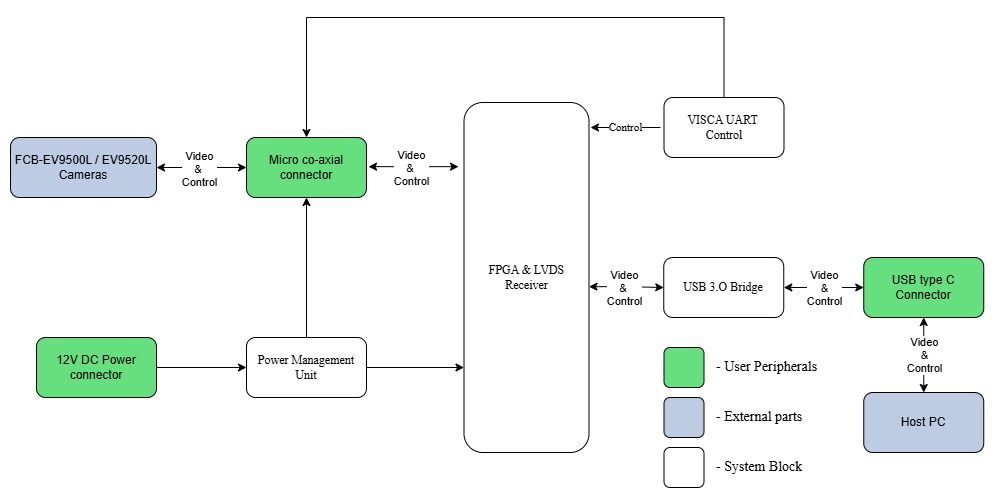
- VISCA camera control through USB CDC or UART TTL
- Stable operation in harsh environments (–40°C to +85°C)
- High-speed data transfer using USB 3.0 SuperSpeed (5 Gbps)
Flow Block Diagram
Key Features
- Converts LVDS video from Sony/Tamron FCB cameras to USB 3.0
- UVC-compliant video streaming (no drivers required)
- Supports VISCA over USB CDC and UART TTL
- DIP-switch selectable control mode
- Wide-temperature, industrial-grade design
- Compact and rugged form factor
- Works out-of-the-box on Windows and Linux
Watch the full video here:
Where It Is Used
This board is ideal for:
- Industrial vision systems
- Medical imaging
- UAV / drone cameras
- Inspection and automation systems
- Robotics and surveillance platformsThe LVDS to USB 3.0 Interface Board enables seamless integration of Sony and Tamron FCB block cameras with any standard USB 3.0 host, converting LVDS video to UVC-compliant 1080p60 USB stream.
Why This Matters
Traditional LVDS output from FCB cameras cannot connect directly to a PC or embedded board.
The LVDS to USB 3.0 Interface Board solves this by converting LVDS → USB while maintaining:
- Low latency
- High reliability
- High-bandwidth video quality
Product Details
Full specifications, kits, and datasheets: LVDS to USB 3.0
Summary
The LVDS to USB 3.0 Interface Board is a compact, industrial-grade converter designed to connect Sony and compatible LVDS block cameras directly to any USB 3.0 host. It supports Full HD 1080p60 UVC streaming, VISCA control over USB or UART, plug-and-play operation on Windows/Linux, and reliable performance from –40°C to +85°C. With easy integration, clear block diagrams, and optional video demonstrations, this blog explains how the board works, its features, applications, and how it enables low-latency, high-bandwidth imaging for AI, robotics, surveillance, drones, and embedded vision systems.
FAQ
It converts LVDS video output from Sony, Tamron, Wonwoo, Videology and Skoopia Block cameras into a USB 3.0 UVC stream for easy integration with Windows or Linux systems.
It supports all LVDS-compatible camera modules that follow the Sony LVDS 30-pin KEL connector pinout (including Sony, Tamron, Wonwoo, Videology and Skoopia Block cameras).
Yes, it supports Full HD 1080p video at 60 frames per second.
Yes, it is fully UVC 1.1 compliant, requiring no additional drivers on Windows or Linux.
Yes, it supports VISCA camera control over USB CDC or UART TTL.
Yes, a DIP switch allows selecting between USB VISCA and UART VISCA control modes.
It is designed for industrial environments with a range of –40°C to +85°C.
Yes, no drivers or setup are required — simply connect and stream.
It supports USB 3.0 SuperSpeed (5 Gbps).
Yes, it is suitable for robotics, surveillance, automation, drones, and medical imaging.
Yes, a full demo video is available at: https://youtu.be/36J7ervP0Nc.
Yes, the board is optimized for real-time low-latency 1080p60 streaming.
No, UVC ensures driverless operation on both Windows and Linux.
The camera’s LVDS output is connected through the board’s LVDS interface before being converted to USB 3.0.
Yes, it works with embedded Linux devices supporting UVC.
It typically operates from standard 12V DC supply depending on camera requirements.
Yes, it is ideal for AI vision, detection, analytics, and robotics pipelines requiring stable 1080p60 input.
Yes, the wide-temperature industrial design ensures reliability in demanding conditions.
Yes, the blog includes a Setup Block Diagram and a Flow Block Diagram for easier visualization.
Full details are available at: https://www.oppila.in/products/camera-interface-boards/usb-interface.