LVDS to MIPI CSI-2 Bridge for Sony FCB Cameras on NVIDIA Jetson Orin Nano/NX Super Developer Kit
High-Performance 1080p60 Low-Latency Video for AI & Embedded Vision
Discover the Oppila LVDS to MIPI CSI-2 Bridge that enables Sony FCB-EV9520L/EV9500L cameras to stream 1080p60 low-latency video on NVIDIA Jetson Orin Nano/NX Super Developer Kit. Includes V4L2 driver, hardware setup, GStreamer pipelines, and real-time AI applications.
Introduction
Integrating industrial LVDS block cameras with modern embedded AI platforms has always required custom hardware and drivers. Oppila’s LVDS to MIPI CSI-2 Bridge Board solves this challenge by enabling Sony FCB-EV9520L / FCB-EV9500L cameras to interface directly with NVIDIA Jetson Orin Nano/NX Super Developer Kit.
This bridge delivers stable 1080p@60fps, sub-millisecond latency, and plug-and-play compatibility, making it ideal for robotics, drones, medical imaging, and real-time AI vision systems.
LVDS To MIPI CSI-2 Conversion
The Oppila LVDS–MIPI Bridge converts Sony’s RAW10 LVDS video stream into MIPI CSI-2 D-PHY output, fully compatible with Jetson platforms.
Key Technical Features
- Supports High-Speed (HS) and Low-Power (LP) MIPI signaling
- Adds CSI-2 headers, ECC and CRC for error-free transmission
- Provides 4-lane MIPI CSI-2 output
- Fixed output: 1080p @ 60fps
- Ultra-low power, low latency link to Jetson
Sony FCB-EV9520L & FCB-EV9500L Camera Block Integration
Sony’s FCB camera family is widely used in industrial and medical applications due to high reliability and image quality.
Camera Features
- 1/2.8" Exmor R CMOS sensor
- 30× optical zoom
- Native 1080p@60fps LVDS output
- EV9520L → better low-light performance
- EV9500L → higher clarity and detail
Combined with the Oppila LVDS to MIPI CSI-2 Bridge, these cameras behave like native MIPI CSI-2 devices, enabling zero-latency computer vision on Jetson platforms.
Custom V4L2 Driver for NVIDIA Jetson Orin Nano/NX Super Developer Kit
Oppila provides a custom V4L2 MIPI driver that registers the LVDS to MIPI CSI-2 Bridge as a media sub-device on the Jetson Orin platform.
Driver Capabilities
- Device Tree Overlay for media graph creation
- RAW10 LVDS → UYVY formatted output
- videobuf2-DMABUF for zero-copy streaming
- Automatic MIPI packetization and link detection
- Exposes standard Linux video node: /dev/video0
Camera exposure and gain are controlled before runtime using VISCA presets, ensuring consistent imaging across AI pipelines.
Camera Control Overview
The bridge also includes I2C-to-UART control, enabling the Jetson Orin Nano/NX Super Developer Kit to send Sony VISCA commands for camera control.
The control path is independent of the video pipeline, ensuring that camera configuration does not introduce latency or disturb real-time streaming.
Control flow:
- Jetson Orin Nano / NX
- I2C interface
- Onboard I2C-to-UART controller (Bridge Board)
- Sony VISCA protocol (UART)
- Sony FCB Camera Block
This architecture allows simultaneous video streaming at 1080p60 and real-time camera parameter control without frame drops.
Supported Camera Controls
The bridge exposes the full Sony VISCA command set, enabling fine-grained control of camera behavior:
Optical & Image Controls
- Optical zoom (tele / wide / absolute positioning)
- Digital zoom enable / disable
- Focus control (auto / manual / one-push)
- Iris (aperture) control
- Gain adjustment
- Shutter speed control
Exposure & Image Quality
- Auto / manual exposure modes
- Backlight compensation
- White balance (auto, indoor, outdoor, one-push)
- Low-light enhancement (critical for EV9520L)
- Noise reduction settings
Operational Controls
- Camera power on/off
- Preset recall (position, zoom, exposure)
- Trigger-based configuration
- Startup default profiles
These controls are especially important in medical imaging, inspection, and surveillance, where consistent imaging parameters are required across sessions.
Hardware Setup & Connectivity
A robust hardware connection ensures stable 1080p60 video transmission.
Required Components
- Jetson Orin Nano/NX Super Developer Kit
- Oppila LVDS → MIPI CSI-2 Bridge Board
- Sony FCB-EV9520L or FCB-EV9500L
Cables:
- Molex 22-pin (54548-2272) → Jetson CAM1 input
- KEL 30-pin (USL00-30L-A) micro-coax → Sony LVDS output
Power:
- Bridge board requires 12V DC @ 0.8A
This chain provides a fixed 1080p60 RAW10 LVDS stream, converted to MIPI CSI-2 in real time.
Block Diagram:
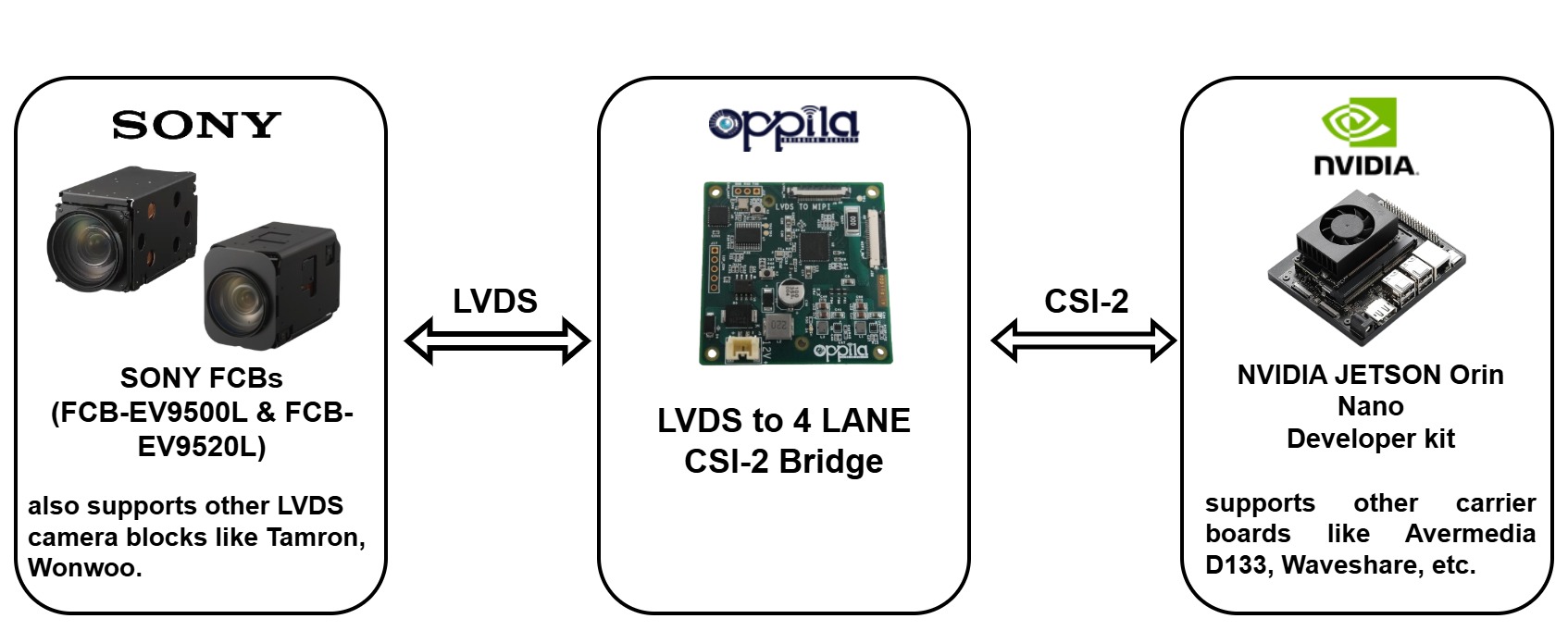
Additional Compatibility
The bridge also supports:
Camera like,
- Tamron LVDS Block Cameras
- Wonwoo LVDS Block Cameras
- Videology LVDS Block Cameras
- Skoopia LVDS Block Cameras
Carrier boards like,
- Avermedia D133
- Waveshare Jetson adapters, etc.
Real-Time 1080p60 Video Streaming with GStreamer
Once the driver is loaded and the link is established, the video stream is accessible at: /dev/video0
Basic GStreamer Pipeline
gst-launch-1.0 v4l2src device=/dev/video0 ! video/x-raw,format=UYVY,width=1920,height=1080,framerate=60/1 ! videoconvert ! autovideosink
Why This Pipeline Works Well
- Uses Jetson’s zero-copy buffers
- Smooth playback at 1080p60
- Minimal CPU load
- No frame drops
- Instant HDMI display
For GPU-Accelerated Rendering
- nvoverlaysink
For Recording / Network Streaming
- nvv4l2h264enc
- rtph264pay
- udpsink
Real-Time Demo
Watch the bridge in action:
Applications
This LVDS–MIPI solution unlocks capabilities for high-end vision systems:
- Robotics & automation
- Medical imaging platforms
- Drones and UAV stabilization
- Industrial inspection systems
- Surveillance and analytics
- AI edge computing using DeepStream or TensorRT
Key Benefits
- Zero dropped frames
- Sub-millisecond pipeline latency
- Stable 1080p60 real-time output
- Low CPU usage
Fully compatible with:
- NVIDIA DeepStream SDK
- OpenCV + TensorRT
- GStreamer Multimedia API
Conclusion
The Oppila LVDS → MIPI CSI-2 Bridge Board transforms Sony’s industrial LVDS block cameras into plug-and-play MIPI devices for Jetson platforms. It delivers high performance, ultra-low latency, and seamless integration with today’s AI and computer-vision stacks.
From drones and medical systems to robotics and surveillance, this bridge enables next-generation embedded vision applications.
Product Details
Full specifications, kits, and datasheets: LVDS to MIPI CSI-2 Bridge
FAQs
No, Sony FCB cameras output LVDS, while NVIDIA Jetson Orin Nano Super Developer Kit requires MIPI CSI-2. Oppila’s LVDS to MIPI CSI-2 Bridge converts LVDS → MIPI CSI-2 seamlessly.
The bridge supports 1080p @ 60fps RAW10, converted to UYVY for Jetson-compatible MIPI CSI-2 streaming.
Latency is sub-millisecond and does not affect AI or real-time applications.
Yes. The LVDS to MIPI CSI-2 Bridge supports VISCA control over an I2C-to-UART interface for zoom, focus, exposure, gain, presets, and triggers.
Sony FCB-EV9520L, FCB-EV9500L, and other LVDS Sony block cameras are supported.
Yes. It supports all LVDS-compatible camera modules that follow the Sony LVDS 30-pin KEL connector pinout including Sony, Tamron, Wonwoo, Videology and Skoopia Block cameras.
The LVDS to MIPI CSI-2 Bridge connects to Jetson Orin Nano/NX Super Developer Kit CAM1 via Molex 54548-2272 22-pin connector.
Yes. A custom V4L2 driver and Device Tree Overlay configure the media graph and CSI-2 pipeline.
Driver outputs UYVY (converted from RAW10 LVDS) via /dev/video0.
Yes. You can use GStreamer, V4L2, ffmpeg, OpenCV, and DeepStream.
gst-launch-1.0 v4l2src device=/dev/video0 ! video/x-raw,format=UYVY,width=1920,height=1080,framerate=60/1 ! videoconvert ! autovideosink
Yes. Replace the sink with: nvoverlaysink
Bridge requires 12V DC @ 0.8A.
Yes. It uses videobuf2-DMABUF, enabling zero-copy pipelines for AI use cases.
Absolutely. The UYVY output is compatible with DeepStream, TensorRT, and Jetson Multimedia API.
A KEL USL00-30L-A 30-pin micro-coax cable is used to connect Sony LVDS output to the bridge.
No. The system maintains full 60fps with zero frame drops under normal operation.
Yes. Add encoding elements such as: nvv4l2h264enc, rtph264pay, udpsink.
Yes. It is compatible with Avermedia D133, Waveshare carrier boards, and other CSI-2 supported platforms.
Robotics, Drones & UAVs, Medical imaging, Industrial inspection, Surveillance & security, Edge AI vision.
Camera control is handled through a dedicated control channel independent of the video stream. The NVIDIA Jetson Orin Nano/NX communicates with the Sony FCB camera using VISCA commands over UART, routed via an onboard I2C-to-UART controller on the Oppila LVDS to MIPI CSI-2 Bridge. This ensures reliable camera control without affecting 1080p60 video performance.
No. Camera control is completely out-of-band from the video pipeline. VISCA commands are processed independently, so zoom, focus, exposure, and gain adjustments do not add latency, drop frames, or disturb the CSI-2 video stream.
The bridge supports the full Sony VISCA command set, including: Optical and digital zoom, Auto and manual focus, Exposure modes, shutter, and gain, Iris control. White balance and low-light enhancement. Preset recall for repeatable camera configurations. This allows precise tuning for industrial, medical, and AI vision workloads.
Yes. Camera parameters are typically configured before the video pipeline starts. This pre-runtime configuration ensures consistent image quality, avoids exposure flicker, and provides a stable input for AI inference models running on DeepStream or TensorRT.
Yes. The control interface allows closed-loop automation, where AI inference results (object size, confidence, or location) can trigger VISCA commands to automatically adjust zoom, focus, or exposure in real time. This is useful for robotics, surveillance, and long-range detection systems.
Yes. Camera control operates independently from V4L2 video capture. VISCA commands can be sent from custom C/C++ or Python applications, robotics frameworks like ROS/ROS2, or system services, while video remains accessible through the standard /dev/video0 node.
Yes. Sony FCB cameras support preset storage, allowing zoom, focus, exposure, and other parameters to be saved and recalled at startup. This ensures repeatable and deterministic camera behavior across reboots, which is critical for industrial and medical deployments.
Full details are available at: https://www.oppila.in/products/camera-interface-boards/usb-interface.